| |
|
JRS Germany -
Political Developments
During 2007, the German government
implemented a number of asylum and immigration European
Union directives and in doing so, enacted major changes
to the German immigration law. Despite heavy criticism
denouncing some of the new provisions - which were in
danger of violating constitutional and international law
- the act came into force on 28 August 2007. Specific
areas of concern were restrictions placed on family
reunification, the definition of a refugee, detention
and changes to the recognition procedure.
The Ministry for Home Affairs reported to the German
parliament that no major changes to the law for
irregular migrants were required. This was in contrast
to the Catholic Forum’s Life in Illegality campaign, of
which JRS is a member, which issued a statement
detailing the problems irregular migrants face and the
urgent need to change relevant legislation.
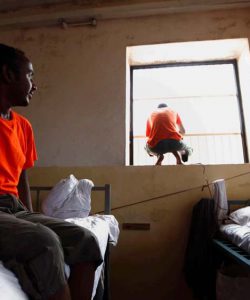
In Germany the number of detainees housed in detention
facilities diminished. During 2007, 1380 people were
detained in the Berlin Detention Centre. This compares
with 1750 in 2006 and 2000 in 2005.
At the beginning of 2007, the number of detainees housed
in the Eisenhuettenstadt detention centre was 20.
Towards the ends of 2007, the number of detainees
awaiting deportation in the centre totalled 80.
|
|
JRS Activities
Detention
JRS Germany continues to visit the main detention centres in
Berlin, Eisenhüttenstadt (Brandenburg) and Munich (Bavaria).
Almost 2,500 detainees were provided with legal, social and
pastoral support during 2007.
The legal aid fund for detainees in Berlin-Brandenburg,
established in 2005, was further developed in 2007. For the
first time, co-funding was received from the European Refugee
Fund (ERF). With a budget of almost 20,000 Euros, 80 legal cases
were assisted. 30 of these cases have already had a successful
outcome.
In November 2007, the legal aid fund was expanded to include
Bavaria in southern Germany. 12 organisations agreed to support
the initiative – among them Caritas Bararia, the Council of
Catholics in the Diocese and the Amnesty International working
group in Munich.
Advocacy
JRS Germany contributed to several NGO conferences discussing
current border control operations and the creation of a
‘Fortress Europe’. FRONTEX, the EU border control agency, is
often highlighted as a successful example of intergovernmental
cooperation in protecting the EU’s external borders. However,
this agency’s performance is being increasingly questioned by
human rights activists. JRS Germany produced a policy paper
criticising Frontex’s activities in relation to protecting the
human rights of refugees and migrants.
On
19th February 2006, the JRS Germany director
reported to the UN Special Rapporteur on the Right to Education,
Mr. Vernor Muňoz, about the right to education for undocumented
young people. Access to the education system for undocumented
migrants remains an ongoing issue. The Grand Coalition of
Christian Democrats and Social Democrats on a federal level
requested the federal government review the situation of
undocumented migrants in Germany. In Hamburg a central register
was set up with data on all pupils attending school there, which
can be accessed by immigration services. In Hessen the Ministry
for Education sent a letter to all public schools informing them
that undocumented children did not have a right to go to school.
Hardship commission
In 2007, there were 9 meetings of the commission for hardship
cases in Berlin, which decided on 220 cases. In 155 cases the
commission recommended to the Berlin Home Secretary to issue a
humanitarian residence status. This was granted in 94 cases. The
JRS Germany team, as representatives of the Catholic Church,
filed 36 applications. The commission decided on a total of 46
applications from 2007 and previous years. In 17 cases the Home
Secretary granted a humanitarian residence status. In 7 other
cases the people were granted a residence permit according to
other regulations. As a result of JRS activities within the
commission, 51 persons were granted the right to stay in
Germany.
Staff News
The former director of JRS Germany in
Berlin was appointed to coordinate and expand the work of JRS in
southern Germany. He will start to work in detention centres
assisting the prison chaplain. It is estimated that 600-700
detainees awaiting deportation are housed each year in Munich;
other prominent centres in Bavaria are Nuremberg (300-400
people) and Regensburg (100-200 people). New staff were also
appointed to visit the detainees awaiting deportation in Berlin
and oversee women’s pastoral care in the detention centre in
Berlin-Köpenick.
Contact Details
Country office:
Martin Stark SJ, Country Director
Jesuiten Flüchtlingsdienst, Witzlebenstr. 30a, 14057 Berlin
Tel: +49-30 3260 2590 - Fax: +49-30 3260 2592 |
Contact in Switzerland:
c/o c/o Lukas Niederberger SJ
CH-6313 Edlibach / Zug
Fon: 0041/ 41/ 757 14 74 - Fax: 0041/ 41/ 757 14 13
lukas.niederberger(a)lassalle-haus.org |
Germany South:
Michael Hainz SJ, Local Coordinator,
Kaulbachstrasse 31a, D - 80539 München
Tel: +49 89 2386 2353 - Fax: +49 89 2386 2352
michael.hainz(a)jrs.net |
Contact in Austria:
c/o Erich Drögsler SJ
Boltzmanngasse 9, A-1090 Wien
Fon: 0043/ 1/ 3108750-28 - Fax: 0043/ 1/ 3108750-31
Johannes König SJ
Dr.-Ignaz-Seipel-Platz , A-1010 Wien
Fon: 0043/ 1/ 5125232-43 - Fax: 0043/ 1/ 5125232-27
johannes.koenig(a)jesuiten.org |
germany(a)jrs.net
To send an email, just replace the (a) with @.
|