| |
JRS Italy -
www.centroastalli.it
|
Political
Developments
In Italy, a comprehensive law on asylum is still
lacking. One of the aims of the new Italian government,
in charge since May 2006, was a radical modification of
the immigration law, the so-called ‘Bossi Fini’.
Unfortunately, nothing changed in 2007, although the
government commenced work on a new migrant citizenship
and integration law.
Two asylum and migration European Directives were
implemented in Italy in 2007:
i) The Council Directive 2004/83/EC of 29 April 2004 on
minimum standards for the qualification and status of
third country nationals or stateless persons as refugees
or as persons who otherwise need international
protection and the content of the protection granted
(which was supposed to be implemented before October
2006); and,
ii) The Council Directive 2005/85/EC of 1 December 2005
on minimum standards on procedures in Member States for
granting and withdrawing refugee status.
These two directives should improve the quality of
asylum assistance in Italy. The implementing Legislative
Decree is the result of many meetings and consultations
between the Ministry of Interior and a group of experts
from Italian NGOs, including JRS Italy. A positive
result of this consultation was the introduction of the
subsidiary protection status, which did not previously
exist in Italian legislation. The term ‘humanitarian
protection’, found in existing Italian law, only granted
a temporary permission to remain. The NGOs’ request to
include more legal guarantees for people appealing
against a negative decision was, unfortunately, not
taken into consideration.
|
|
 |
JRS Activities
Social Assistance
Several new
projects started in 2007. A new centre offering assistance and
health care to asylum seekers and refugees - Salute per Migranti
Forzati - was opened in Rome. The project was a partnership
between JRS Italy and the Italian National Health Service with
the support of the UNHCR. The objective of the project was to
encourage forced migrants to access the National Health Service
by improving the State’s capacity to address the needs of this
target group. Specific services were offered to victims of
torture, in collaboration with the NGO ‘Medici contro la tortura’.
A new accommodation centre was inaugurated in Catania, Sicily. A
building confiscated from the Mafia was given to JRS Italy and
turned into a shelter for 60 people. The centre was named after
Father Pino Puglisi, an Italian priest shot dead by the Mafia in
1993 because of his engagement in the Palermo neighbourhood of
Brancaccio. The shelter was particularly necessary in Catania,
where many existing centres for homeless people and migrants
were closed due to a lack of public funds.
Two school projects were offered
in 2006 to students in several Italian towns: “Finestre - Storie
di Rifugiati”, on asylum rights and integration and “Incontri”,
on the knowledge of different religions and interfaith dialogue.
A training course for volunteers on the rights of migrants in
Italy (“I diritti non sono stranieri”) in Rome was attended by
more than 120 people between March and May 2006.
In December 2006 JRS Italy celebrated 25 years of activity with
a public conference on migration in The Gregorian University,
Rome and a concert in the Church of Sant’Ignazio. A video was
produced for the occasion, where the most significant steps of
Centro Astalli’s story were recalled.
Skills Training
A training course for migrants, financed
by the Regional Authority, was organised in Rome from June to
December. 23 migrants from 16 different countries participated.
The course included 400 hours of classes and 100 hours of
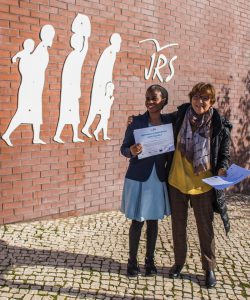
apprenticeship. After the final exam, all participants obtained
an official qualification in social work.
Advocacy
JRS Italy took part in a research
project, whose preliminary findings were launched in November
2007, concerning the conditions of destitute failed asylum
seekers in Rome and Lazio. The aim of the research was to
understand the problems these individuals face and use this
information to plan how to offer more effective support and
assistance in the future. Questionnaires were distributed to one
hundred destitute failed asylum seekers with personal
testimonies and stories collected from a further fifteen. For
many of the individuals – usually young men from Africa and Asia
who were smuggled into Italy – the inability to work was the
most difficult thing to endure.
Awareness Raising
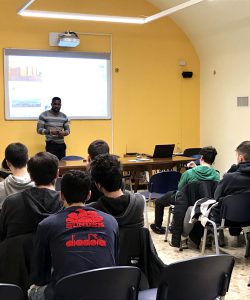
During 2007, thousands of high
school students took part in two projects offered by JRS Italy
on the right to asylum and interfaith dialogue. Many of them
took part in a writing competition 'La lettura non va in esilio’,
supported by the Ministry of Cultural Heritage. The students had
to write a short story about the theme of the project. The
winner, a student from Liguria, will take part in a trip to
Senegal organised for a group of students by the Municipality of
Rome. The 10 best stories were published in a book.
Contact Details
Fr Giovanni La Manna SJ, Country Director
Associazione Centro Astalli, Via degli Astalli 14/A - I-00186
Roma
Tel: +39-06 697 003 06 or + 39-06 678 12 46 - Fax: +39-06 679 67
83
italy(a)jrs.net
To send an email, just replace the (a) with @.
|