| |
EU Policy and JRS Advocacy
Background and Context
JRS Europe:
 |
studies emerging EU law on asylum
|
 |
advocates for just asylum policies based on the dignity of the
person |
 |
brings the concerns of JRS workers in developing countries to
the attention of the decision makers in the EU.
The European Union (EU) is widening and
deepening its asylum and immigration policy as
well as relevant legislation. JRS-Europe follows
the policy-making and legislative process,
analyses it and provides comments. It advocates
at relevant stages of the legislative
procedures. In Europe, 18 national JRS Offices
and Contact Persons contribute to JRS-Europe's
advocacy. At the global level, JRS-Europe
co-operates with other JRS Regional Offices and
the JRS-International Office in Rome.
Recently, the legislative decision-making
process in the EU changed considerably. Until
2004, the European Parliament (EU Parliament),
representing the citizens of the EU, only held a
consultative role in the legislative process,
and the European Council (EU Council),
representing the Member States of the European
Union (EU Member States), was the only EU
institution which had the right to adopt
legislation. Since 1 January 2005 however,
co-decision has become the rule in the fields of
asylum, immigration (except illegal immigration)
and border control issues; the EU Council and
the EU Parliament adopt EU legislation jointly.
This requires that the two EU institutions have
to agree on an identical text proposed by the
European Commission (EU Commission). The role of
the EU Commission, representing the overall
interests of the EU, remains unchanged: the EU
Commission has the exclusive right to propose,
among EU legislative acts, in particular EU
directives.
An EU 'directive' must be transposed into the
national law of the EU Member States as follows:
'A directive shall be binding, as to the result
to be achieved, upon each Member State to which
it is addressed, but shall leave to the national
authorities the choice of forms and methods'.
(Art. 249 Treaty of Amsterdam)
|
|
|
JRS Europe's Advocacy
Focus: Administrative Detention
of Asylum Seekers and Irregular Migrants
Most JRS staff in Europe visit
detention centres, which hold not only irregular
immigrants but increasingly asylum applicants as well. From this experience, JRS Europe has decided to
focus on the issue of the detention of asylum seekers and
irregular migrants in Europe and is advocating for changes at EU
level. |
|

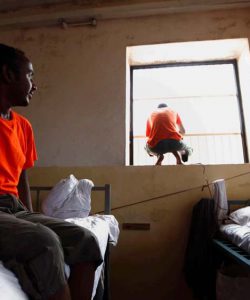
Detention Centre in Malta |
Activities of JRS Europe
 |
JRS-Europe is a partner in an academic
legal research project covering all 25 EU Member States.
It is a comparative study: rights/realities of (1.)
nationals in prison, (2.) foreigners in prison and (3.)
administrative detention of asylum seekers and irregular
migrants. The EU Commission Employment and Social funds
the project, which is a project in the context of
"social exclusion". JRS-Europe is covering only
administrative detention at the EU level. The study
follows guidelines developed by the Law Faculty of
Tilburg University / The Netherlands.
|
 |
February 2005: Brussels, Belgium. JRS-Europe presented
the JRS-Europe Detention document to Members of the EU
Parliament. |
 |
October 2004: Brussels,
Belgium. JRS-EUROPE presented the JRS-Europe detention document
to the Dutch EU Presidency and to representatives of UNHCR,
of Permanent Representations and Missions, of the Church and of
NGOs. |
 |
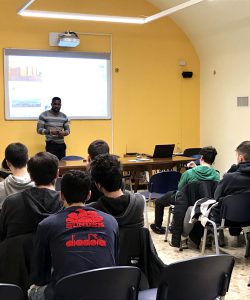
Sept 2004: Postojna, Slovenia:
JRS-Europe held a seminar for police and other staff
at the detention centre about detention in Europe
|
|
Administrative Detention of
Asylum Seekers and Irregular Migrants in Europe:
Common Position of JRS in Europe
JRS' document, 'Administrative Detention of Asylum
Seekers and Irregular Migrants in Europe: Common
Position of JRS in Europe,' establishes JRS' opposition
to administrative detention and the conditions that must
be adhered to for those who are already in detention.
The members of JRS in Europe define
'administrative detention' as:
 |
A situation in which a third-country national is confined
within a narrowly bounded or restricted location, and where
he or she experiences a deprivation of liberty; this measure
must be for administrative reasons and not a measure of the
criminal justice system. |
The members of JRS in Europe agree to the following
principles:
 |
Anyone who is fleeing from severe human rights violations
has an inalienable right to seek protection in another
country. |
 |
Individuals and their families shall not be punished,
administratively or criminally, for submitting an asylum
claim by the national authorities of the country to which
they seek protection. |
 |
Authorities of the countries of reception shall take the
utmost care to provide for the well-being and safety of
asylum applicants. |
 |
Children who seek asylum in another country, whether they
are accompanied or not, and by reasons of their physical and
mental vulnerability, require the provision of special
safeguards and care, including appropriate legal protection
and the unity of the family, as to the extent that it is in
the best interest of the child. |
The members of JRS in Europe agree
to the following positions:
 |
No asylum seeker shall be detained during his or her asylum
procedure. |
 |
Administrative detention shall not be used as a deterrent
against persons who seek asylum. |
 |
Administrative detention of irregular migrants shall be
avoided to the utmost extent possible. |
 |
If detention cannot be avoided, it should be only used in
accordance with the principle of proportionality. |
 |
Legislation shall provide for, and policy makers shall
implement, alternatives to detention that respect human
dignity and fundamental human rights. |
 |
Families with children shall not be detained in closed
detention centres. Family unity shall be maintained at all
times, as long as it is in the best interest of the child.
Alternatives to detention must be found in the case of
families. |
 |
Unaccompanied minors, including age-disputed minors, shall
never be detained. |
 |
Vulnerable persons such as minors, pregnant and lactating
women, traumatised persons, persons with special physical or
mental health needs, persons older than 65 years and
chronically or seriously ill persons, shall never be
detained. |
 |
A person may be detained only if there has been a prior
decision by an independent judicial authority. If a prior
judicial decision cannot be obtained, the person’s detention
shall be subject to an automatic review before a judicial
body that is readily accessible and effective, at a time not
exceeding 48 hours after the detention measure is ordered.
The detention order shall be subject to subsequent automatic
reviews by a judicial authority at least once every 30 days. |
|
 |
Detainees shall be provided with timely and free legal
assistance that meets a sufficient quality standard, and
shall be immediately informed of the reasons for his or her
detention and the legal means of challenging the detention
order, in a language the person understands. The costs for
competent professional interpretation shall be covered by
the State. |
 |
Administrative detention shall be as short as possible, and
in every case, shall not exceed two months. |
 |
Living conditions in detention centres such as nutrition,
accommodation, access to health care, privacy, telephone and
access to indoor as well as outdoor activities, shall comply
with basic human rights standards and should not resemble a
prison-lie environment. Detainees shall have access to
education and shall be able to practise their religion. |
 |
Detainees shall have the right to receive visits from the
outside world, including social, familial and pastoral
visits. Detainees shall also have the right to contact the
outside world by telephone or by mail. Simultaneously,
representatives of relevant non-governmental organisations
and of the United Nations High Commissioner for Refugees (UNHCR)
shall be granted access to detention facilities without
being required to name a particular person they want to see. |
 |
EU and national monitoring mechanisms and bodies shall be
established to independently monitor the use of
administrative detention for asylum seekers and irregular
migrants, and to inspect places of administrative detention. |
|
|
|
Advocacy documents
JRS-Europe positions papers and
comments
Joint Comments from the
Platform of Christian Organisations at a European Union level
|
 |
September 2007 -
Comments on the European Commission's Green Paper on the
future Common European Asylum System (pdf
file) [192KB] |
 |
September |
 |
May 2006 -
Comments on the European Communication on "Migration and
Development: Some concrete orientations" COM (2005) 390
final |
 |
March
2006 -
Comments on the European Commission's Proposal for a
Directive on common standards and procedures in Member
States for returning illegally staying third-country
nationals |
 |
March
2005 -
Churches and Christian Organisations in Europe on Migration
and Asylum |
 |
December 2004 -
Joint comments of Caritas, CCME, COMECE, ICMC, JRS-Europe &
QCEA on Integrating Migrants - Integrating Socities:
Essential Elements for EU Migration Policy COM (2004) |
 |
October
2004 - Towards a
Balanced Approach in EU and Migration
Policy - 12 Recommendations'
[EN]
[DE]
[FR] |
 |
August 2004 -
Joint comments of Caritas, CCME, COMECE, ICMC, JRS-Europe &
QCEA on the assessment of the Tampere Programme and
future orientations COM (2004) 401 final |
 |
April 2004 -
Joint comments of Caritas, CCME, COMECE,
Eurodiaconia, ICMC, JRS-Europe & QCEA on the
Communication from the European Commission on Immigration,
Integration and Employment COM (2003) 336 |
 |
June 2003 -
Joint Comment of Caritas, CCME, COMECE,
Eurodiaconia, ICMC, JRS-Europe & QCEA on the development of
a common policy on illegal immigration, smuggling and
trafficking of human beings, external borders and the return
of illegal residents COM (2003) 323 |
 |
June 2003 -
Joint comments of Caritas, CCME, COMECE,
Eurodiaconia, ICMC, JRS-Europe & QCEA on the EC
Communication to the Council and the European Parliament
towards more accessible, equitable and managed asylum
systems (COM(2003) 315 final) |
Joint positions with others
|
|